Make Compliance Gap Analysis Audit Ready With Obligation Mapping

A compliance gap analysis compares your current controls, policies, and evidence against a chosen benchmark standard to find exactly where you’d fail an audit today. The goal is audit readiness, not just awareness. Your immediate next step is to define the scope of what you’re reviewing and pick the benchmark framework you’re measuring against before you touch a single control.
TL;DR:
- A compliance gap analysis is checklist-driven, not risk-based, and requires specific controls, policies, and evidence matching each benchmark requirement.
- Conduct the analysis before audits, after major changes like M&A or new product launches, and regularly update the scope to focus on high-risk areas.
- Build a detailed obligations register linking requirements to controls, owners, evidence locations, and test methods to produce a snapshot for auditors.
- Prioritize gaps based on penalty exposure, customer impact, regulatory activity, and strategic importance to focus remediation efforts effectively.
- Maintain the mapping regularly with scheduled reviews and automated change alerts to avoid outdated controls that create false confidence.
Table of Contents
- What a Compliance Gap Analysis Actually Checks
- When to Run a Gap Analysis and How to Scope It
- The Step-by-Step Compliance Gap Analysis Process
- Obligation-to-Control Mapping: An Operational Model
- Scoring and Prioritization: Turning Findings Into Rank
- Remediation Roadmap and Governance
- Evidence Collection and Testing for Audit Packaging
- Where Automation Helps and Where It Doesn’t
- Reporting That Proves Progress
- Keeping the Map Current
- Permitly’s Take: Operationalizing the Map, Not Just Building It
- Sources
What a Compliance Gap Analysis Actually Checks
A compliance gap analysis is a normative exercise. You take a benchmark, whether that’s SOC 2, ISO 27001, HIPAA, PCI DSS, or a NIST framework, and you check each requirement against what you actually have in place. Do the control, the policy, and the evidence exist? Yes, partially, or no. That’s fundamentally different from a risk assessment, which is probabilistic. Risk assessment asks “how likely is this to go wrong and how bad would it be.” Gap analysis asks “does this control exist and can you prove it.” One source on compliance gap analysis draws this line clearly: gap analysis is checklist-driven, risk assessment is scenario-driven, and conflating the two is how compliance teams end up with vague findings nobody can act on.
Regulators care about this distinction more than most compliance teams realize. When the Department of Justice or a sector regulator evaluates whether a compliance program is legitimate, they’re not asking whether you’ve thought about risk in the abstract. They’re asking whether your program is well-designed, adequately resourced, and actually working, and rule mapping and testing evidence is what they look at to answer that. A risk register full of hypotheticals doesn’t hold up in an enforcement conversation. A mapping document that shows requirement, control, evidence, and test date does.
This is where gap analysis earns its keep for audit prep specifically. Auditors don’t want your opinion that you’re probably fine. They want a paper trail: here’s the requirement, here’s the control that satisfies it, here’s the evidence, here’s when we last tested it. A properly run compliance assessment builds that trail as a byproduct of the process itself. You’re not creating documentation after the fact to survive an audit. You’re creating it because the analysis forces you to.
A few things a gap analysis reliably surfaces that teams don’t expect going in:
- Controls that exist on paper but nobody can produce evidence for
- Policies written for a framework version the organization no longer follows
- Owners who left the company and were never reassigned
- Evidence sitting in personal email folders instead of a shared system
- Controls that satisfy one framework but not the newer one the business now needs
None of that shows up in a risk heat map. It shows up when you sit down and try to match a specific clause to a specific control and can’t.
When to Run a Gap Analysis and How to Scope It
Cadence matters as much as method. Most compliance teams run a full regulatory compliance review annually, with lighter quarterly checkpoints on the highest-risk areas. That’s the routine baseline. But routine cadence isn’t the only trigger you need to plan for.
Event-driven assessments matter more in practice than the calendar-based ones, because they’re the ones that catch you off guard if you don’t plan for them:
- Pre-audit, ideally 60 to 90 days before an external audit or certification renewal, so remediation has time to land before an auditor shows up.
- Mergers and acquisitions, since you’re inheriting another company’s control environment, and it rarely matches yours.
- New product or market launch, especially one that triggers a new framework, like adding payment processing and suddenly owing PCI compliance.
- Regulatory change, when a law or standard updates and your existing mapping goes stale overnight.
- Vendor or platform change, when a new subprocessor or infrastructure provider shifts where evidence lives and who’s accountable for it.
Scoping is where most teams overreach. Trying to map every framework across every business unit in one pass produces a document nobody finishes and nobody trusts. Pick your scope by asking three questions: which framework applies, which business units and assets touch it, and which processes actually generate the evidence. Start with whatever carries the highest penalty exposure or the most active regulatory attention, get that mapping to full strength, then expand outward. A narrow, complete map beats a broad, half-finished one every time.
The Step-by-Step Compliance Gap Analysis Process
Here’s the sequence that holds up whether you’re running your first regulatory gap assessment or your fifth.
Step 1: Define scope, objectives, and benchmark. Decide which framework you’re measuring against and which parts of the business are in scope. Write down what “done” looks like: full mapping strength on every applicable clause, or acceptable partial mapping on lower-risk items. Foley’s guidance on running these assessments makes this the foundational step for good reason. Establishing scope before gathering documentation keeps the whole project from sprawling.
Step 2: Inventory controls, policies, evidence, and owners. Pull every policy document, control description, and piece of evidence you currently have. Assign a named owner to each. This step alone often takes longer than expected, because most organizations discover they don’t actually know who owns half their controls until they try to write it down.
Step 3: Map clauses to controls and assign mapping-strength ratings. For every requirement in your benchmark, find the control that’s supposed to satisfy it and rate the match: full, partial, or none. A full mapping means the control fully satisfies the requirement and you have current evidence. Partial means the control exists but doesn’t cover the whole requirement, or the evidence is stale. None means there’s no control at all, an orphan requirement sitting exposed.
Step 4: Identify and categorize gaps. Not all gaps are the same kind of problem, and lumping them together wastes remediation effort. Separate them into:
- Design gaps, where the control doesn’t exist or wasn’t built to actually satisfy the requirement
- Operating gaps, where the control exists on paper but isn’t consistently followed in practice
- Evidence gaps, where the control likely works but nobody can produce proof of it
Step 5: Prioritize and assign remediation tasks with owners and deadlines. Every gap becomes a ticket. Every ticket gets an owner, a deadline, and a description of what “closed” looks like. Vague findings like “improve access controls” don’t get fixed. Specific tickets like “implement quarterly access review for the finance system, owner: IT security lead, due: March 15” do.
Step 6: Re-test controls and monitor status. Once remediation is marked complete, someone independent of the person who did the work re-tests it. This is also where you set the review cadence going forward, so this doesn’t turn into a one-time exercise you repeat from scratch every year.
Pro Tip: Run Step 3 as a spreadsheet with one row per requirement before you invest in any specialized mapping software. You’ll spot patterns, like a whole clause family with no controls, faster in a flat table than in a tool that hides the gaps behind a dashboard.
The stakeholders who need a seat at this table go beyond the compliance team itself. Legal needs to weigh in on how requirements are interpreted, especially anything ambiguous. Internal audit needs visibility so the eventual audit isn’t a surprise. And the actual business owners of each control, not just the compliance function, need to sign off on findings that touch their area. Skipping stakeholder engagement is the single most common reason a gap analysis produces findings that quietly get ignored six months later.
Obligation-to-Control Mapping: An Operational Model
The mapping itself is the deliverable an auditor actually wants to see, more than any narrative summary you could write about your compliance posture. The model that holds up under scrutiny links five things for every single requirement: the obligation, the control that satisfies it, the owner accountable for it, the evidence location, and the test method used to verify it.
Build this as a formal obligations register, not a loose set of notes. Give each requirement a stable Requirement ID and cite the source clause directly, whether that’s a specific SOC 2 trust services criterion or a numbered HIPAA safeguard. According to guidance on mapping legal obligations to regulations, a defensible mapping row needs the requirement, the linked control, the mapping-strength rating, the evidence type, the test method, the owner, and the last review date, all in one place, all traceable.
For each row in the register, you’re recording:
- The obligation, cited back to its source clause or Requirement ID
- The control or controls that address it, since some requirements need more than one
- The owner, a named person, not a department
- The evidence location, the exact system or folder where proof lives, not “somewhere in Sharepoint”
- The test method, whether that’s a design review, a sample test, or a full trace
- The review cadence, how often this specific row gets re-verified
Mapping-strength ratings do double duty here. They tell you where the real gaps are, but they also become a metric you track over time. If your full-mapping percentage improves significantly between two assessments, that’s a number you can put in front of leadership. Orphan rules, requirements with no control at all, deserve their own tracked count, since they’re the highest-risk items in the entire register and tend to hide in the least-reviewed corners of a framework.
When you package this for an auditor, resist the temptation to hand over a live, editable document. Auditors want a versioned snapshot: the mapping as it stood on a specific date, with the evidence that existed at that moment, frozen. That means exporting the register, the linked evidence artifacts, and the test results together, then locking that bundle down as the version you’re standing behind for that audit cycle. If the mapping changes next quarter, that’s a new snapshot, not an edit to the old one.
Scoring and Prioritization: Turning Findings Into Rank
Not every gap deserves the same urgency, and treating them all the same is how remediation budgets get wasted on low-value fixes while the dangerous ones sit untouched. Score each gap across a few concrete axes:
- Penalty exposure, how large a fine or sanction this specific gap could trigger
- Customer impact, whether a failure here would directly affect customers or their data
- Enforcement activity, whether regulators have recently been active on this exact requirement
- Regulatory change velocity, how fast this area of law or standard is currently shifting
- Strategic dependency, whether a major deal, certification, or contract depends on this specific control
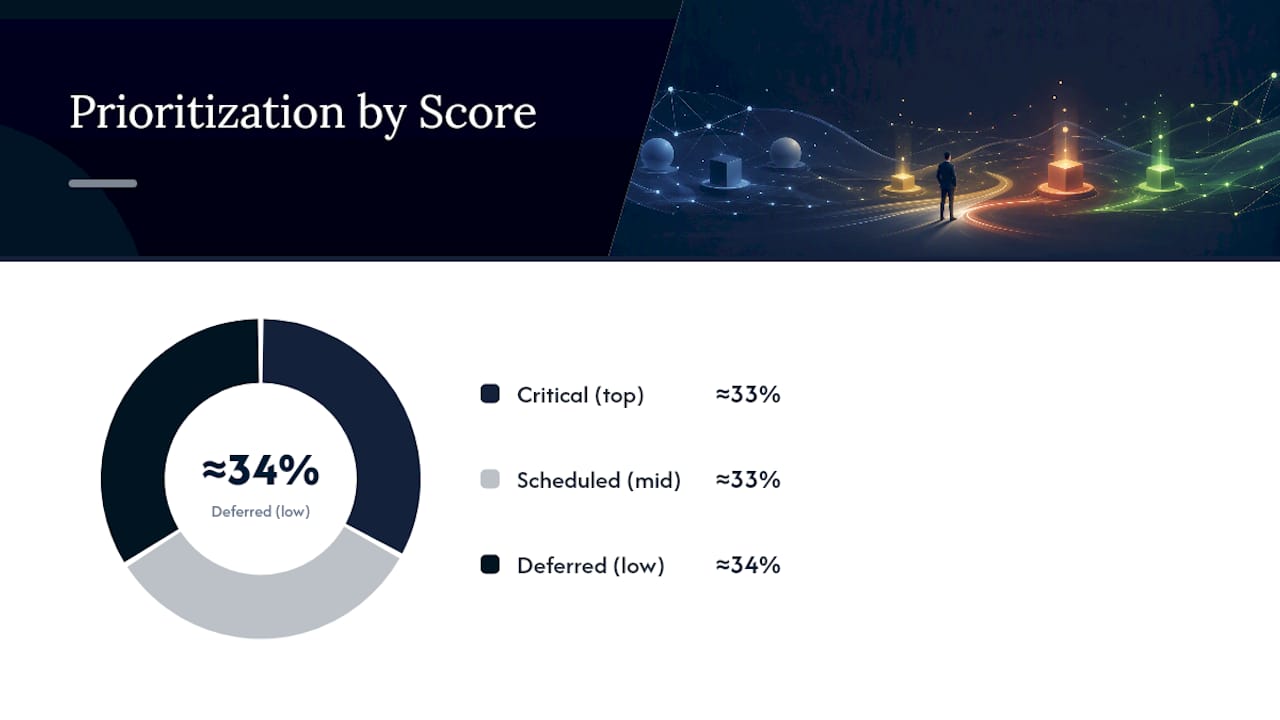
A simple weighted score works better than an elaborate model nobody will maintain. Score each axis 1 to 3, weight penalty exposure and customer impact higher than the others, and add it up. Gaps scoring in the top third become critical and go to remediation immediately. The middle third gets scheduled into the next sprint. The bottom third gets logged and revisited at the next quarterly review, not ignored, just not fought over this week.
Pro Tip: Weight enforcement activity higher than most teams do by instinct. A requirement with moderate penalty exposure but a recent wave of regulatory actions against it is a worse bet to leave open than a theoretically bigger penalty that hasn’t seen enforcement in years.
This scoring step is what separates a gap analysis that actually changes behavior from one that just produces a long list nobody reads past page two. Leadership doesn’t need forty findings. They need three critical items, a dozen medium ones with dates attached, and a short tail of low-priority items they can safely defer.
Remediation Roadmap and Governance
Every finding from the gap analysis needs to become a real ticket, not a bullet point in a report that gets filed away. Each ticket carries an owner, a specific deliverable, a due date, and a description of the evidence that will prove the gap is closed.
- Convert findings into tickets immediately after scoring, while the context is still fresh and the priority ranking is still visible. Waiting even a few weeks lets urgency evaporate.
- Group remediation into phased sprints rather than one giant backlog. Critical items get their own short sprint. Medium items get folded into the next regular planning cycle.
- Run cross-functional reviews at the end of each sprint, pulling in legal, the business owner, and compliance together to confirm a fix actually satisfies the original requirement, not just the symptom.
- Verify with an independent test, either internal audit or an outside reviewer, before marking anything closed. The person who built the fix should not be the person who signs off on it.
- Feed verified closures back into the mapping register, updating the mapping-strength rating and the evidence location so the register reflects reality, not the plan from three months ago.
Governance breaks down most often at the handoff between “ticket closed” and “mapping updated.” Teams fix the control, mark the ticket done, and never circle back to update the obligations register itself. Six months later the register says “partial” on a requirement that’s actually fully remediated, and nobody trusts the document anymore. Building that feedback loop into your workflow, so closing a ticket automatically triggers a mapping update, is worth more than almost any other governance change you could make.
Evidence Collection and Testing for Audit Packaging
Auditors accept specific evidence types, and vague documentation gets rejected more often than compliance teams expect. You need system logs, screenshots with timestamps, signed attestations, dated policy versions, and training completion records, each tied directly to the control it’s proving.
Test approach depends on the control type. A design review confirms the control was built correctly on paper. Sampling checks a subset of transactions or events against the control’s requirements. Full-trace testing follows a single item end to end through the entire process, which is slower but is what auditors reach for when a control has failed before or carries high risk.
Package everything as a bundle per mapping row: the requirement, the linked control, the test method used, the actual evidence artifacts, and a version stamp marking exactly when this snapshot was taken. That bundle is what you hand over, not a narrative summary and not a folder of loosely organized files. An auditor working through SOC 2 trust services criteria expects to see clause-to-control mapping backed by evidence in exactly this structure, and a bundle that’s missing the test method or the version stamp gets flagged for follow-up questions that slow the whole audit down.
Where Automation Helps and Where It Doesn’t
Automation earns its place in a few specific jobs: classifying regulatory text, routing tasks to the right control owner, sending reminders before evidence goes stale, collecting evidence automatically from connected systems, and flagging when a regulation changes. Automated compliance frameworks convert regulatory text into assigned work items for control owners, which genuinely speeds up how fast a team responds to a new rule.
But automation has real limits, and pretending otherwise creates gaps you won’t see until an auditor finds them:
- Ambiguous clauses in a regulation still need a human legal reviewer to interpret intent, not just a keyword match
- Nonstandard contractual obligations, the kind buried in a specific vendor contract rather than a public regulation, rarely fit a standard mapping template
- Edge cases where a control almost satisfies a requirement but not quite tend to get auto-classified as “full” when they’re really “partial”
The workflow that actually works pairs the two. Let automation handle classification, routing, and change detection, the repetitive work that doesn’t need judgment. Keep a human reviewer in the loop for anything flagged as ambiguous or materially changed. Mapping regulations to internal processes works best once you’ve standardized the internal process model first, obligation, trigger, owner, system, evidence, and review frequency, because automation applied to a messy, undefined process just automates the mess faster.
Reporting That Proves Progress
Stakeholders and auditors both want the same handful of reports, just for different reasons:
- Coverage summary, the percentage of requirements at full, partial, and none mapping strength per framework
- Gap log, every open item with its owner, priority score, SLA deadline, and current status
- Test results summary, what’s been re-tested recently and what the change log shows since the last snapshot
- Executive KPIs, a short set of numbers, like percentage of critical gaps closed on time, that a board can actually digest without reading the full register
Keep these separate documents rather than one sprawling report. A board member wants the KPI page. An auditor wants the gap log and coverage summary. Nobody outside compliance wants to wade through all of it to find their piece.
Keeping the Map Current
A mapping that isn’t maintained becomes worse than no mapping at all, because it creates false confidence. Run quarterly reviews on your highest-risk areas and a full remapping annually at minimum.
Between those scheduled reviews, specific triggers should force an immediate update: a regulatory amendment, a product launch that changes what you’re subject to, an acquisition, or a new vendor touching regulated data. According to guidance on maintaining legal obligation mappings, the strongest programs build a change-management workflow that automatically opens a remediation ticket the moment a mapping row changes, rather than relying on someone remembering to check.
Permitly’s Take: Operationalizing the Map, Not Just Building It
Most compliance teams don’t fail at building the mapping. They fail at keeping it alive after the audit ends and everyone moves on to the next fire. The register that mattered so much in March is stale by September, and nobody notices until the next auditor asks for evidence that no longer exists.
That’s the gap Usepermitly was built to close. The platform centers on a single hub for licenses, permits, certifications, and insurance, so the obligations register isn’t a spreadsheet that rots. Renewal dates, owners, and evidence live in one place with automated reminders attached, which turns “review cadence” from a calendar note into something that actually happens. The software includes an AI assistant that answers compliance questions, builds checklists from given requirements, and reads uploaded documents to flag what’s missing, automating tasks that would otherwise depend on manual efforts.
None of that replaces the judgment a real compliance program needs. It replaces the part of the job that shouldn’t require judgment at all: remembering, chasing, and re-checking. If your organization is still running its obligations register in a spreadsheet nobody updates on schedule, a centralized hub like Permitly is worth a serious look, and the pricing page lays out what that looks like for a team your size.
— Marat
Sources
For deeper detail beyond this guide, KPMG’s risk and compliance mapping assessment covers automation at scale. Foley’s five best practices for a compliance gap analysis walks through stakeholder engagement in more depth. For the operational mapping model itself, see how to map regulations to internal processes automatically.